Garnois: The Hand-Drawn Typeface That Commands Attention
There’s a particular kind of energy that only comes from something made by hand. It’s the slight imperfection of a marker stroke, the weight of a brush pressed against paper, the unmistakable character that digital perfection often strips away. In a world saturated with sleek, minimal typography, there’s a growing hunger for fonts that feel human, textured, and unapologetically bold. Enter Garnois, a hand-drawn font family that doesn’t just sit on the page—it practically jumps off it. This isn’t another generic display typeface; it’s a carefully crafted tool for designers, entrepreneurs, and creators who understand that sometimes, to make your message heard, you need to turn up the volume.
More Than Just Thick Lines: Understanding the Garnois Visual Language
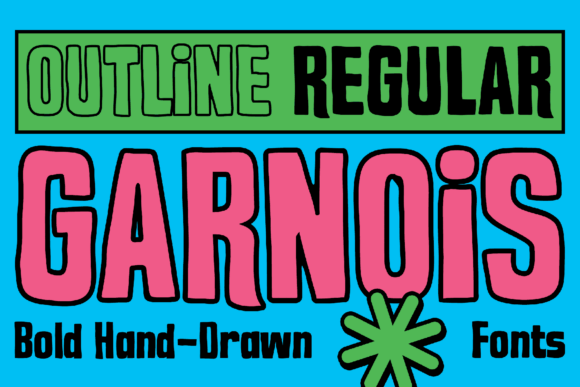
At first glance, Garnois makes an impression with its substantial, organic forms. The letterforms are thick, with playful, rounded silhouettes that evoke the DIY aesthetic of hand-painted posters and the vibrant pop culture of street art. But the real genius lies in its construction as a system. Garnois isn’t a single font; it’s a dynamic duo. The family includes both a solid Regular version and a crisp Outline version. These two styles are perfectly aligned, meaning you can stack them to create instant, professional-grade dimensional typography. Imagine a headline where the solid letters are layered with a slightly offset outline in a contrasting color—the result is a 3D effect that adds depth, shadow, and a layer of visual interest that flat text simply cannot achieve. This stackable feature makes Garnois a uniquely versatile design asset, moving it from a simple creative font to a foundational element for building complex, eye-catching compositions.
Where Bold Typography Finds Its Home: Practical Applications
The true test of any premium font is its real-world application. Garnois’s personality makes it a natural fit for projects where impact and character are non-negotiable. For brand identity, it’s a game-changer for brands targeting a youthful, energetic audience—think a Gen-Z startup, an indie music festival, or a vibrant streetwear label. Its hand-crafted feel instantly communicates authenticity and creativity, helping to build immediate brand recognition. In packaging design, particularly for organic snacks, craft beverages, or artisanal goods, Garnois’s tactile quality bridges the gap between industrial production and the handmade, telling a story of care and personality before the product is even opened.
Beyond physical products, its applications are vast. As a display font for poster design, it guarantees your event or promotion will be noticed from a distance. For social media graphics, its boldness cuts through the endless scroll, making it perfect for impactful quotes, sale announcements, or video thumbnails. It can lend a playful, approachable tone to a website header or a blog title, setting the mood instantly. Even in editorial design or for digital products like e-book covers, Garnois can be used strategically for chapter headings or key callouts to guide the reader’s eye. The key is to use it for short, high-impact text—headlines, logos, and call-to-action phrases—where its character can shine without compromising readability for longer passages.
Matching Font Personality to Project Goals
Choosing a font is a strategic decision, not just an aesthetic one. The style of your typography must align with the message you want to convey. Garnois speaks a language of energy, playfulness, and handmade authenticity. Before selecting it, ask yourself: does my project goal match this voice? If you’re designing a logo design for a serene yoga studio or a luxury law firm, Garnois might be too loud. But for a children’s toy brand, a community fundraiser, or a YouTube channel focused on creative hacks, it’s an ideal match. Its strength lies in adding a human touch without sacrificing a professional edge—a crucial balance for commercial projects.
When integrating Garnois into a broader visual system, consider font pairing. A font with this much personality often benefits from being paired with a cleaner, more neutral companion. A simple sans-serif or a classic serif font can provide a grounding contrast for body text, ensuring your overall design remains balanced and legible. This approach maintains visual hierarchy: Garnois grabs attention for the big ideas, while the supporting font carries the detailed information. Always test your pairings in context—see how they look on a mockup of your packaging or in a social media post template before finalizing.
From Screen to Print: Ensuring Consistency and Impact
One of the practical advantages of a well-built font family like Garnois is the promise of visual consistency. Whether your design ends up on a tiny mobile screen or a large-format print banner, the core character of the typeface remains. This consistency is vital for building a coherent brand identity across all touchpoints. However, readability considerations are paramount. Due to its display nature and thick strokes, test Garnois at the intended size and medium. Ensure there is sufficient contrast between the text and its background. For print materials like merchandise or invitations, consider how the ink will sit on the paper; a textured stock might complement its handmade feel beautifully.
Before launching any project, review the included font styles thoroughly. Experiment with the Regular and Outline versions separately and in combination. Play with color overlays, slight rotations, or scaling to discover unique dimensional effects. This exploration is part of the creative process and can lead to more innovative marketing assets. Finally, for any commercial use, always verify the licensing of your commercial font to ensure it covers your specific project, whether it’s for client work, products for sale, or digital distribution. Garnois is designed to be a workhorse for bold ideas. It’s the shortcut to a look that feels both professionally executed and authentically human. When your design needs to make a statement, sometimes the best tool is one that refuses to whisper.